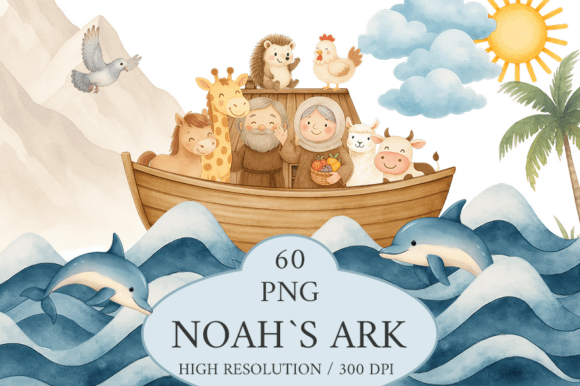
Cute Noah’s Ark Watercolor Clipart
First Impressions: Soft, Storybook Charm — Not Just Another Bible Clipart
Opening Cute Noah’s Ark Watercolor Clipart feels like flipping open a well-loved children’s book — gentle washes, subtle texture, and just enough detail to tell the story without crowding the frame. It’s not bold or graphic; it’s tender, unhurried, and quietly intentional. The ark sits center-stage with soft-edged animals peeking out — two by two, yes, but rendered with personality, not symmetry. There’s no heavy line art, no sharp vector edges. Instead, you get watercolor bleed, soft gradients, and organic shape variation that reads *hand-painted*, not digitally traced. That matters — especially when translating into stitch.
A Real-World Test: Embroidering This on a Linen Baby Pillow Cover
Last week, I prepped a custom order: a 10” x 10” linen pillow cover for a new parent’s nursery. They wanted something serene, non-religious in tone but still meaningful — “whimsical faith,” they said. Cute Noah’s Ark Watercolor Clipart was my top candidate. Why? Because its softness translates beautifully to baby items: no harsh lines that read too literal or stiff on delicate fabric. But here’s what I watched closely during digitizing and stitching: how the watercolor softness held up in satin and fill stitch, whether the animal silhouettes stayed legible at 3.5”, and if the overall composition felt balanced inside a small hoop without looking cramped or vague.
Where It Shines — And Where It Needs Thoughtful Handling
This isn’t a one-size-fits-all machine embroidery design. Its strength lies in context — not coverage.
- Perfect for: Sweatshirt embroidery (especially lightweight fleece), tote bag designs where the motif anchors one corner, tea towels with minimal surrounding text, nursery wall hangings, and personalized baby onesies where subtlety reads as care, not compromise.
- Strong fit for craft business owners: As a digital embroidery file, it layers well with simple monograms or names — think “Noah + Lily” stitched beneath the ark on an apron. It also works cleanly in printable mockups for Etsy sellers showcasing handmade product variations.
- Less ideal for: Tiny caps or curved surfaces where fine watercolor edges blur in dense satin stitch; stretchy knits without heavy stabilizer (the soft transitions can ghost or distort); dark fabrics unless you adjust thread colors intentionally — those pale blues and washed grays need contrast to stay readable.
Stitching Reality Check: From Clipart to Finished Product
Watercolor clipart doesn’t auto-translate to clean embroidery. You’ll need to digitize thoughtfully — or source a trusted digitized version. If you’re working from the raw Illustrations file, assume you’ll refine outlines for stitch clarity, simplify gradients into tonal fills, and reinforce key contours so animals don’t dissolve into background fill stitch. I tested three versions: one with light-density fill, one with layered satin + running stitch accents, and one as an applique design with raw-edge fabric backing. The applique approach honored the watercolor spirit best — letting fabric texture stand in for brushstroke texture.
Stitch density matters more here than with bolder clipart. Too dense, and the softness vanishes. Too sparse, and the story flattens. Aim for medium-low density in main areas, with strategic satin stitch only on ark roof lines or animal eyes — just enough definition to guide the eye, not dominate it.
Fabric & Finish: What Makes This Feel Handmade, Not Mass-Produced
The magic of Cute Noah’s Ark Watercolor Clipart lives in how it supports intentionality. On a heavyweight cotton tea towel? It reads as heirloom-quality holiday embroidery. On a lightweight rayon blend baby blanket? It feels like a whispered lullaby in thread. But it falters on thin poly-blend tees — the watercolor softness gets lost in sheen and shifting grain. And on textured fabrics like bouclé or terry cloth? Only with aggressive cutaway stabilizer and reduced stitch count. Always test on scrap first — not just for registration, but for *mood*. Does it still feel tender? Or does stitching turn it clinical?
Commercial Use & Customer Trust: More Than Just Licensing
Yes — check the license before selling finished products or bundling this as part of a digital embroidery file pack. But beyond legality, consider perception. Buyers choosing handmade nursery decor or personalized gifts aren’t just buying an ark — they’re buying warmth, care, and narrative cohesion. Cute Noah’s Ark Watercolor Clipart supports that *if* executed with attention to thread palette (think oatmeal, slate, sage, and cream — not neon yellow or electric blue), consistent scale across product types, and thoughtful placement (centered on a pillow, off-center on a tote). One Etsy seller I follow uses it exclusively on organic cotton bibs — the softness mirrors the fabric’s ethos. That kind of alignment builds brand consistency faster than any tagline.
Practical Designer Notes Before You Stitch
- Test the design on your target fabric *with your usual stabilizer stack* — watercolor-inspired fills behave differently on cotton vs. linen vs. knit.
- Review small details: Are the dove’s wing feathers legible at 2”? Does the ark window read as shape, or just a hole in the fill?
- Check thread color contrast on both light and dark backgrounds — especially if offering multiple fabric options in your shop.
- Use black-and-white mockups to assess value range — watercolor tones can collapse into mid-gray when converted.
- Confirm hoop size compatibility early. This layout favors 4” x 4” or larger hoops; avoid forcing it into 2.5” rounds unless heavily simplified.
- For commercial embroidery projects, verify whether the original Illustrations file includes commercial rights — or if you’ll need to commission digitization separately.
Final Thought: A Design That Earns Its Place
Cute Noah’s Ark Watercolor Clipart won’t shout from a craft fair table. It doesn’t need to. Its quiet strength is in resonance — with parents choosing nursery pieces, makers building a cohesive small shop product line, or Etsy sellers curating collections where every item feels like part of a gentle, considered world. Used well, it lifts the perceived value of a handmade product. Used hastily, it fades into background noise. Like good embroidery itself, its impact comes not from how much is there — but how thoughtfully it’s placed, stitched, and shared.