Virgin Mary Clipart – 46 Designs: Illustrations for Soulful Branding
As a brand designer who’s developed visual identities for over two dozen local businesses—from artisanal olive oil producers in California to Catholic-themed candle studios in New Orleans—I approached Virgin Mary Clipart – 46 Designs not as a generic digital product, but as a potential graphic design asset for real-world small business branding. My immediate test? Applying it to a new client project: a family-run Dominican bakery launching a line of “Nuestra Señora”-inspired pastries and coffee blends—think guava empanadas, spiced café con leche, and hand-poured candles with Marian motifs.
A Warm, Reverent Mood—Not Just Religious, But Rooted
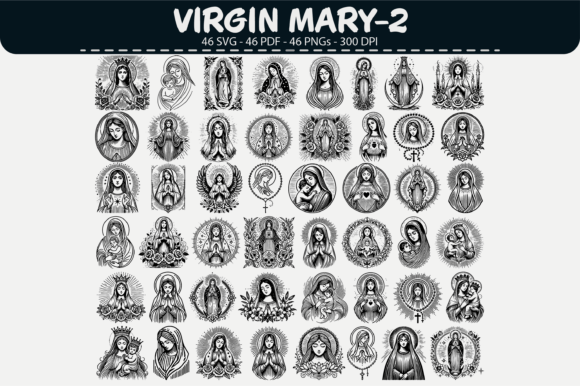
The first impression of Virgin Mary Clipart – 46 Designs is deeply human—not stiff or iconographic, but tender, grounded, and quietly elegant. These are not mass-produced devotional stamps; they’re expressive illustrations with soft linework, gentle shading, and subtle texture—some in delicate watercolor washes, others in clean vector strokes. The mood leans toward organic, feminine, and soulful—ideal for businesses that prioritize authenticity over trend-chasing. It feels handmade without looking amateurish, reverent without being austere. That makes it a natural fit for food labels, boutique packaging, skincare branding, and seasonal campaigns where emotional resonance matters more than flashy novelty.
Where This Graphic Design Asset Earns Its Place in Local Business Branding
In the bakery project, we used three designs from Virgin Mary Clipart – 46 Designs across multiple touchpoints—with intention, not decoration:
- Product labels: A simplified halo-and-profile silhouette anchors the front of our pastry boxes—paired with serif typography and cream kraft paper for instant warmth and shelf appeal.
- Packaging accents: A floral-mantle variation wraps around the bottom edge of our coffee bag, creating visual rhythm without overwhelming the bold brand name.
- Social media graphics: A gentle full-figure illustration appears in Instagram carousels announcing our “Feast Day Specials”—softening the tone while reinforcing cultural connection.
- Thank-you cards & hang tags: Smaller, line-art versions print crisply on recycled cardstock—adding sincerity to unboxing moments.
- Seasonal campaign visuals: For December, we layered a gold-foil version over velvet-textured banners—elevating holiday gifting without sacrificing brand consistency.
This isn’t clipart dropped in place—it’s a considered part of the brand identity. When applied thoughtfully, Virgin Mary Clipart – 46 Designs strengthens first impressions, deepens product recognition, supports clearer visual hierarchy, and builds customer trust through visual sincerity.
Where It Shines—and Where It Needs Careful Placement
Virgin Mary Clipart – 46 Designs works best when it serves as a quiet anchor—not the sole voice. It excels in:
- Hero graphics for website banners and in-store signage
- Decorative brand elements (borders, corner flourishes, background repeats)
- Product mockups for Etsy, Shopify, or local market displays
- Boutique visuals—especially for faith-based, heritage-driven, or culturally rooted businesses
- Printable design inserts like recipe cards or blessing bookmarks
But caution is needed where clarity and compliance matter most. Avoid using it:
- In formal corporate branding (e.g., law firms or financial advisors)
- On very small labels where detail blurs at 0.5" height
- In ingredient-heavy layouts—where it competes with regulatory text
- Over low-contrast backgrounds (e.g., light gray on white), which mute its emotional weight
- In luxury minimalist brands that rely on negative space and restraint
Practical Brand Designer Notes You Can’t Skip
Before locking in Virgin Mary Clipart – 46 Designs for your small business branding, run these checks:
- Test it on real packaging mockups—not just digital previews. Does it hold up on matte kraft, glossy sticker stock, or linen-finish cards?
- Check black-and-white usage: Some illustrations lose subtlety when converted—verify legibility for monochrome printing or embossing.
- Preview it on small labels: Zoom out to actual size—does the expression read at 3/8” height?
- Test it with your brand colors: Does the warmth of the illustration clash with cool-toned palettes—or harmonize beautifully?
- Compare it with competitor packaging: Does it differentiate your product or blend in too easily?
- Review print quality: Confirm resolution meets commercial standards—especially if ordering large-format posters or retail displays.
- Inspect SVG or vector editability: Can you adjust line weight, recolor mantles, or isolate elements for flexible reuse?
- Test it beside your fonts: Try pairing with serif, sans serif, script, handwritten, and display typefaces—some illustrations sing with calligraphic lettering but feel stiff next to geometric sans.
- Confirm commercial licensing: Ensure your use case—client work, physical product sales, social ads—is explicitly covered. Not all creative marketplace licenses permit resale on merchandise.
More Than Clipart—A Bridge Between Heritage and Modern Design
What makes Virgin Mary Clipart – 46 Designs stand out among digital illustration libraries is its balance: reverence without rigidity, tradition without stagnation. For a handmade soap business infusing prayers into lavender-scented bars, it becomes a subtle signature. For a children’s book publisher releasing bilingual Marian stories, it offers gentle, age-appropriate visual language. For a florist crafting altar arrangements for weddings and feast days, it elevates digital invites and thank-you notes with quiet dignity.
It’s not about plastering sacred imagery everywhere—it’s about choosing a graphic design asset that aligns with your local business values, speaks authentically to your community, and supports professional branding without compromising meaning. In an era where customers seek purpose and presence—not just polish—Virgin Mary Clipart – 46 Designs delivers both. Used with care, it doesn’t just decorate packaging or social feeds. It helps tell a story that’s already true: one of care, continuity, and quiet conviction.